
How market volatility can work to your advantage through consistent investing to build a resilient financial portfolio
When markets fall, your immediate thought might be to sell. What you don't realise is that if you try to time the market, it could cost you more to leave than to stay invested. This is where Dollar-Cost Averaging (DCA) can be put to work.
DCA is a disciplined investment approach where you invest a fixed amount of money regularly, regardless of market condition or asset price fluctuations. Instead of trying to predict when to invest, you commit to consistent contributions, making it a habit instead of a reaction to the market. Over time, DCA can lower the average price per unit purchased and provide the protential for higher capital appreciation.
In simpler terms: You invest the same amount every month, whether the markets are up or down.
DCA doesn't tell you what investment to buy (that's between you and your adviser), but it does away with the problem of trying to figure out when to buy. With DCA, you spread out your contribution in equal amounts over a pre-determined preriod of time.
Since your contribution amount stays the same, you buy more units when share prices are low, and fewer units when prices are high.
Over time, this helps to:
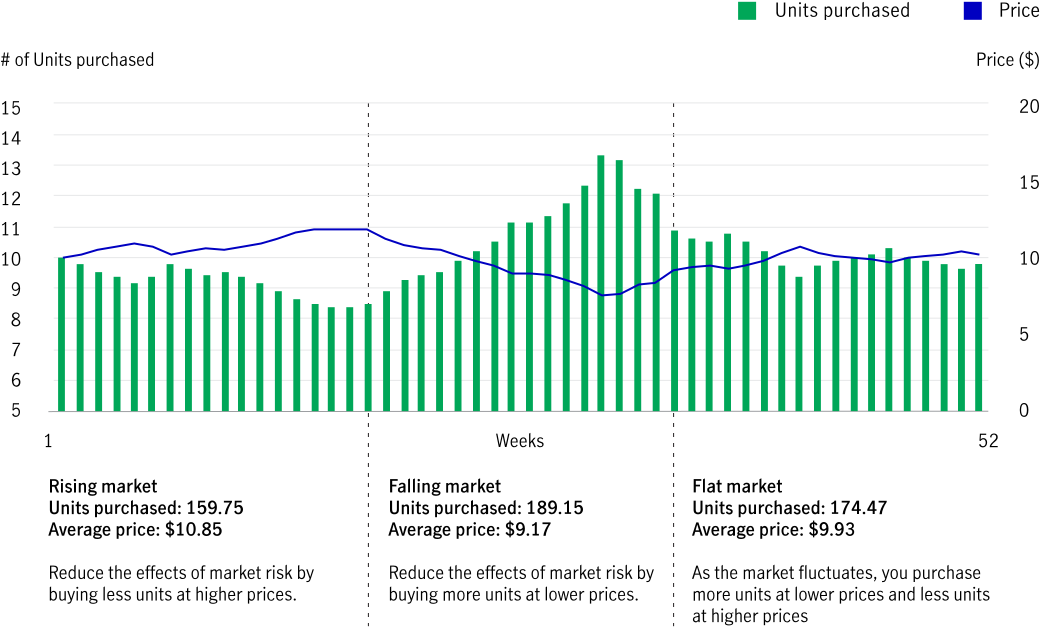
The table presented is for illustrative purposes only. It does not reflect real data and should not be interpreted as an accurate representation of actual figures or outcomes.
In this case, the investor that utilises DCA ended up with more units and avoided the stress of choosing the 'right time', focusing on long term growth.
The average cost per unit becomes balanced over time.
DCA works well with automation!
You can set up Regular Savings Plan (RSP) to make it easier to stay invested through bear or bull market swings.
There's no one-size-fits-all answer when comparing DCA vs. lump sum investing. Each has its own potential advantages depending on goals, risk tolerance and how confident you feel about the market. However, here are some differences between them both.
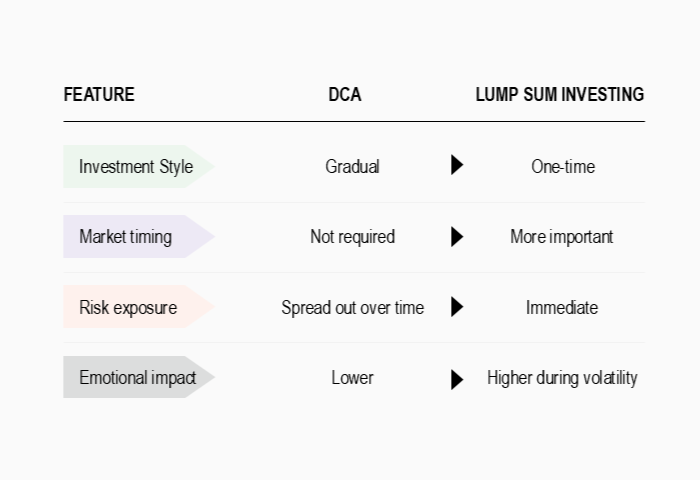
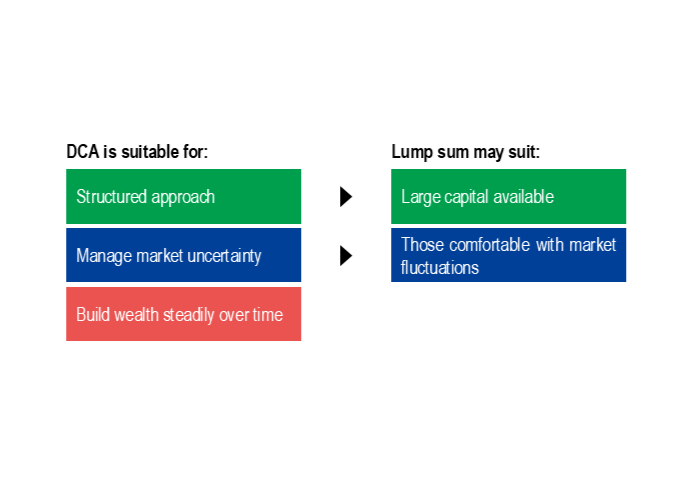
Ultimately, the right option depends on your comfort level, state of the market, and whether you're investing a lump sum or contributing over time.
Market volatility can feel uncomfortable, but this is where DCA can turn to work in your favour.
How DCA helps during market downturns:
Market dips can be opportunities, not obstacles when you invest consistently.
A regular savings plan (RSP) makes it easy to apply DCA, helping you invest consistently without having to monitor the market.
Why consider RSP?
Start with your GOAL
Instead of asking, 'How much should I invest?' start with 'What do I want to achieve?'
When you define your goal first, your investment plan becomes clearer. Then the next step is to break it down into something manageable.
Big financial goals don't have to start big, they can start small.

©1999 - 2026 Manulife Investment Management (M) Berhad (Registration No. 200801033087 (834424-U))





