

29 May 2024
Traditionally, many Asian investors prefer the perceived safety of the money market and bank deposits, allocating an average of 40% of their assets to cash to achieve their financial goals.1 However, in the close-to-zero interest-rate environment that followed the global financial crisis, investors began to seek different products that offered a higher income.
Even though interest rates are now higher, achieving a regular income remains a priority for Asian investors. Through income investing, Asian investors not only capture a potentially higher income than cash but may also earn capital gains from their investments.
Note that income products are not risk-free and carry no guarantees. Thus, we believe moving towards a “Better Income” approach that balances risk, growth, and income to reflect investors’ needs is important.
The “Better Income” approach is designed to understand an investor’s objectives and the underlying risks associated with certain levels of income generation. Income brings with it varying levels of risk commensurate with the amount of income an investor seeks.
For example, a younger investor with a long-term horizon may be ready to sacrifice some short-term income in pursuit of wealth accumulation, whereas a retiree may want to preserve their capital and seek a regular income level just above cash rates.
Remember, “income” is not “interest”, and it is not “risk-free”. That’s why investors should understand how their portfolios can be built around the level of risk they are willing to take. What’s more, “Better” does not necessarily mean the highest income level but rather the stability and consistency of reasonably higher yields generated throughout various market cycles.
We believe that investors should thoroughly understand a particular source of income and its investment risk profile to achieve a stable income while making their capital last as long as possible.
Different sources of income
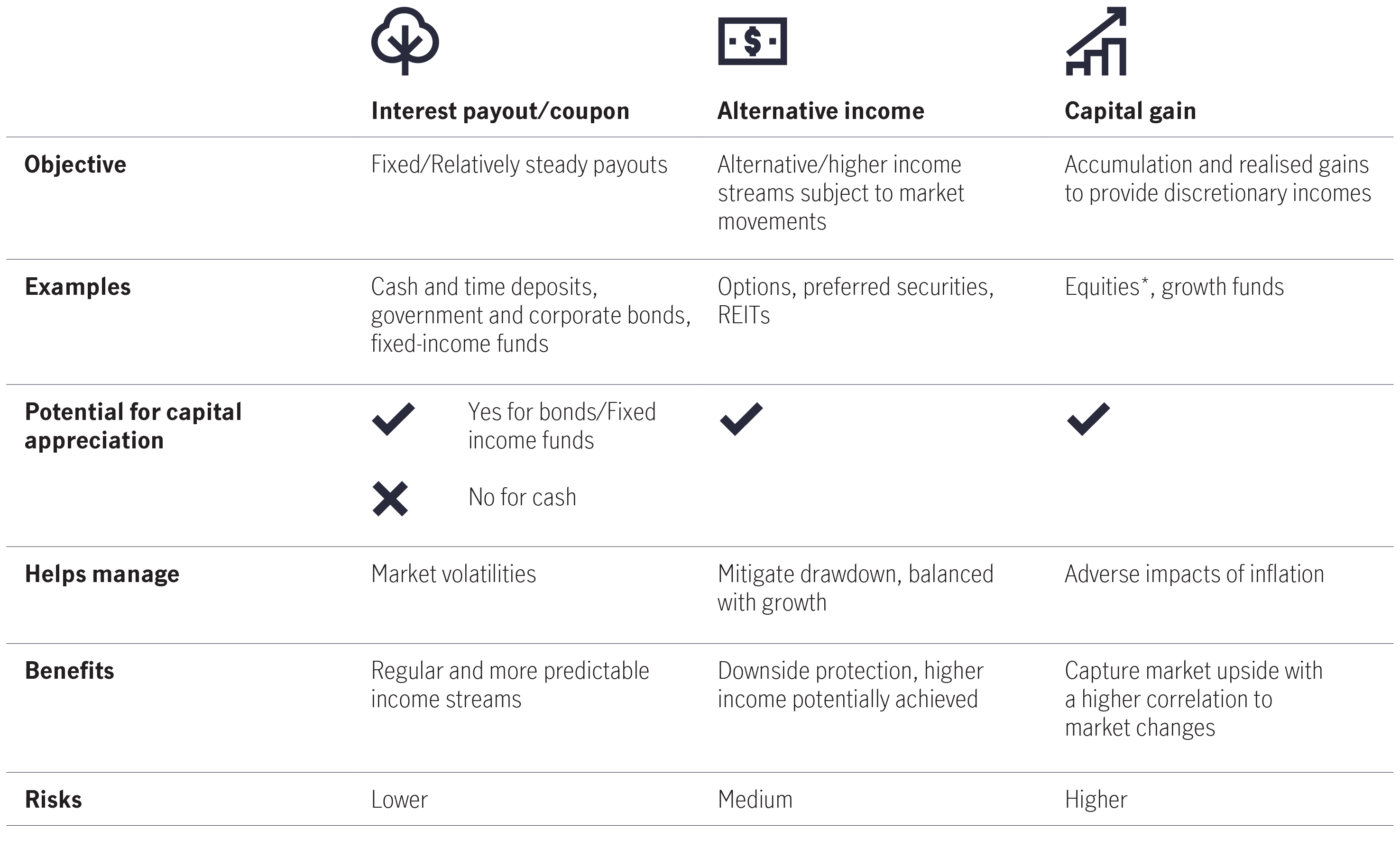
*Investors may directly receive an income (in the form of dividends) if they hold equities. Alternatively, they may indirectly receive an income (in the form of distributions) if they own mutual funds, exchange-traded funds (ETFs), or other pooled vehicles that hold equities.
Distribution of incomes, the frequency of distribution and the amount/rate of incomes are not guaranteed. Positive distribution yield does not imply positive return.
1 Manulife Investment Management commissioned NielsenIQ to conduct an online survey of 2,000 people from Hong Kong, Taiwan, Indonesia, and Malaysia – 500 people from each market – who are aged 20 to 60 between 25 August and 6 September 2022. The research aims to assess people’s retirement readiness and aspirations, including savings and investments, and lifestyles and family issues they consider when planning for retirement.
How to Set Smart and Effective Financial Goals
In previous episodes, we have explored creating a financial plan and establishing a budget that accounts for your current expenditure. The third step is to build a strategy that will help you accomplish either a short-term or a long-term financial goal. We will guide you on your path by providing financial goal examples and introducing SMART (specific, measurable, attainable, relevant, time-based) objectives that help clearly define what you want to achieve in the years ahead.
5 ways a budget plan can help you manage your finances
We all know approximately how much money we need each month. However, without a clear spending strategy, you could see a shortfall in savings, face a lack of day-to-day cash, or be caught off guard by unexpected costs. That’s why it’s important to have an effective budget plan that will give you control over your finances.
Portfolio Diversification: What it is and How it Works?
Watching on the U.S. mid-terms? What history tells us about market performance and behaviour
As U.S. midterm elections approach in November, louder headlines may tempt some investors to wait on the sidelines. We believe history offers some useful context for understanding market behaviour around election cycles. Here is what decades of election-cycle data may tell us, and why patience has often mattered.
10 Questions about Supranational Bonds
What are supranational bonds? Learn how bonds issued by international institutions may offer high credit quality, competitive yields and portfolio diversification. Explore their general features, key considerations and discover why supranational bonds could complement a diversified fixed-income allocation across markets, currencies and different interest-rate environments.
Navigating higher for longer rates: Scarce real assets, enduring demand
Real assets offer exposure to some of the most essential parts of the global economy, from energy networks and critical infrastructure to inflation-linked securities and selected real estate sectors. In a world of elevated geopolitical risks, shifting supply chains and ongoing inflation concerns, these assets can provide both resilience and diversification when traditional markets face pressure.
Disclaimer:
The above information has not been reviewed by the SC and is subject to the relevant warning, disclaimer, qualification or terms and conditions stated herein. Manulife Investment Management (M) Berhad Registration No: 200801033087 (834424-U) (hereinafter referred to as “Manulife IM (Malaysia)”) is a wholly owned subsidiary of Manulife Holdings Berhad and holds a Capital Markets Services License for fund management, dealing in securities restricted to unit trusts, dealing in private retirement schemes and financial planning under the Capital Markets and Services Act 2007. Manulife IM (Malaysia) operates under the brand name of Manulife Investment Management which is the global wealth and asset management segment of Manulife Financial Corporation. Information posted herein is intended for the exclusive use by the recipients who are allowed to receive it under the applicable laws and regulations of the relevant jurisdictions. Certain information in this post may contain projections or other forward-looking statements regarding future events, targets, management discipline, estimates or other development trends of financial markets. There is no assurance that such events will occur, and actual results may be significantly different from what is contained herein.
Information contained herein has been obtained and/or derived from sources believed to be reliable, Manulife IM (Malaysia) makes no representation as to its accuracy or completeness and expressly disclaims any liability whatsoever for any loss howsoever arising from or in reliance upon the whole or any part of this information or any information contained in third party website linked to this post. Neither Manulife IM (Malaysia) or its affiliates, nor any of their directors, officers or employees shall assume any liability or responsibility for any direct or indirect loss or damage or any other consequence of any person acting or not acting in reliance on the information contained herein. Investment involves risk, including the loss of principal. Investors should rely on their own evaluation to assess the merits and risk of the investment. In considering the investment or the information provided, investors who are in doubt as to the action to be taken should consult their professional adviser. The information provided herein is for information purposes only and should not be construed as and shall not form part of an offer or solicitation to buy or sell any unit trust funds/ wholesale funds/ private retirement schemes. Information contained herein may subject to change without prior notice and may not be reproduced, distributed or published by any recipient for any purpose.

©1999 - 2026 Manulife Investment Management (M) Berhad (Registration No. 200801033087 (834424-U))


